Write Your Literature Review in Weeks, Not Months A structured AI workflow to find, read, analyse, and write your literature review β€” systematically, ethically, and using free tools. πŸ“¦ 5 modules  Β·  🎬 35+ videos  Β·  βœ… One complete system from first search to final draft Enrol Now β€” $109  $49 Launch Price  Β·  Save $60 Designed for master's students, PhD candidates, and researchers across any discipline. Instant access  Β·  14-day money-back guarantee  Β·  Free tools only

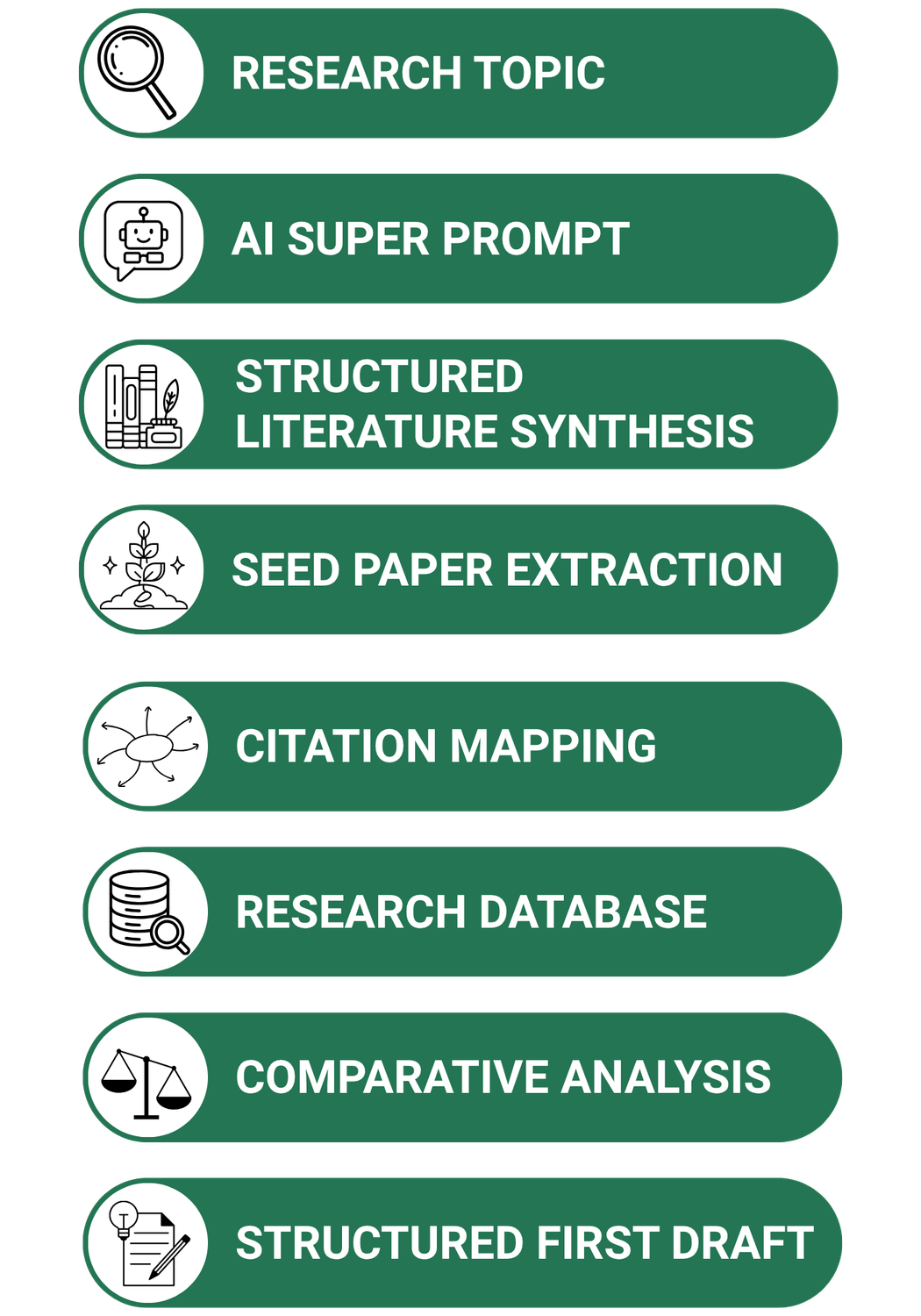
The AI Literature Review Workflow

Research Topic β€” You start with your research question, however broad or narrow.

AI Super Prompt β€” ChatGPT transforms your topic into an optimised prompt that guides the AI agent toward comprehensive results.

Structured Literature Synthesis β€” Edison Scientific's Falcon returns a full literature review draft with ranked references and search queries, typically within 20–30 minutes.

Seed Paper Extraction β€” You pull the highest-quality papers, Boolean search strings, keywords, and theoretical frameworks from the AI output.

Citation Mapping β€” Research Rabbit runs forward, backward, and lateral searches from your seed papers β€” surfacing work that keyword searches alone miss.

Research Database β€” Every paper is processed through NotebookLM and entered into the pre-built Notion template β€” a living, searchable database of your entire landscape.

Comparative Analysis β€” Notion AI compares findings across 30–50 papers, maps contradictions, and surfaces genuine research gaps.

Structured First Draft β€” Your database generates the first draft of each section β€” grounded in your own notes, your critical judgments, and proper citations.
You already know the problem.

If you are here, you have probably experienced some version of this:

βœ•

Random keyword searches that go nowhere.

βœ•

PDFs piling up without a system.

βœ•

Re-reading papers you have already processed.

βœ•

A quiet worry that you might have missed something important.

The traditional approach works.
Eventually.
But it is slow, scattered, and stressful.

Which means you spend weeks building a literature base you cannot fully trust.
Which means the research gap you identified might not hold up β€” and you would not know until it is too late.

This is a systems problem.
And this course gives you the system.

Before vs. After

❌ Without the System
βœ… With the System
4–8 weeks of scattered searching
Under 1 hour with AI-generated synthesis
Keyword guessing, repeated with different terms
AI-generated starting point followed by targeted expansion
Folders of PDFs, scattered highlights, notes in multiple apps
Centralised Notion research database with automated tracking, filtering, and structured fields
Manual reading and forgotten highlights
AI-assisted extraction via NotebookLM β€” key contributions, methods, and limitations in minutes
Uncertain research gap
Data-driven: comparative analysis across 30+ papers reveals patterns and contradictions
"I think I covered everything"
"I have a verified, systematic record of my entire research landscape"

What the course covers

1
Literature Review Fundamentals What a literature review is β€” and is not. Three core functions, structural approaches, and a three-pass reading method. Experienced researchers can skip this. Newer researchers: this is the foundation.
2
Finding and Ranking Literature with AI ChatGPT prompt engineering β†’ Edison Scientific's Falcon synthesis β†’ seed paper extraction β†’ Research Rabbit citation mapping β†’ Google Scholar verification. Result: a comprehensive, ranked literature collection.
3
Reading, Understanding, and Building Your Database NotebookLM as your reading companion. Upload papers, extract structured insights in minutes. Everything feeds into the Notion template. Comparative prompts for analysing dozens of papers at once.
4
Comparative Analysis and Gap Identification Notes become critical synthesis. Notion AI compares findings across all papers, maps contradictions, surfaces gaps, and helps define your angle. You leave with drafted sections.
5
Writing and Polishing Your Literature Review Database becomes publication. Structure your review, draft sections from notes, refine language, run plagiarism and citation checks. Ready for submission.

Everything inside the course.

Component What It Includes Why It Matters
5 Modules Full literature review process β€” fundamentals through final writing Complete end-to-end system, not disconnected tips
35+ Video Lessons ~3 hours of focused instruction, no filler Learn the full workflow in a single focused day
AI Prompt Library Every prompt used in the course, copy-paste ready Skip the trial and error β€” use tested, optimised prompts
Notion Template Pre-built literature tracker with automated fields, reading timelines, keyword filtering Your database builds itself as you work β€” organise 100+ sources clearly
Workflow Guides Step-by-step sequences across ChatGPT, Edison Scientific, Research Rabbit, NotebookLM, Notion AI Know exactly which tool to use, when, and how they connect
Pre-Submission Checklist Structure, citations, academic tone, plagiarism checks Submit with confidence, not anxiety
Lifetime Access All current and future updates Use the system for every literature review in your career

Here is what you can realistically expect.

No inflated claims. These are conservative estimates based on the workflow design:

βœ“

Reduce initial search and organisation time by 40–70% β€” by starting with an AI-generated synthesis instead of blank keyword searches.

βœ“

Process 2–3x more papers per week β€” using NotebookLM's structured extraction instead of manual reading and annotation.

βœ“

Compare 30–50 papers in a single analysis session β€” using Notion AI comparative prompts across your full database.

βœ“

Organise 100+ sources without losing track β€” using the pre-built Notion template with automated filtering, timelines, and fields.

The exact results depend on your discipline, your existing skills, and how thoroughly you implement the system. But the workflow is designed to eliminate the biggest bottlenecks in the traditional approach.

Why I built this

Aynur β€” Chemical Engineering PhD Candidate AYNUR ATALAY Chemical Engineering PhD Candidate

Imperial College London
Top 10 University Globally
I built this course because I needed it myself. I am a final-year Chemical Engineering PhD candidate at a top 10 university globally. I have spent years working inside academic literature β€” reading hundreds of papers, navigating complex citation networks, and building the kind of structured research arguments that PhD-level work demands. When I started my literature review, I did everything the traditional way. I searched Google Scholar with keywords I thought were right, downloaded hundreds of papers, highlighted things I would later forget, and spent weeks building a literature base I could not fully trust. The problem was never effort or ability. It was the absence of a repeatable system. The turning point came when I realised that structure matters more than intelligence when you are working across hundreds of papers in a complex field. Once I developed a workflow β€” AI-generated starting points, mapping tools for systematic expansion, a structured database to capture everything β€” the process changed completely. My review went from a source of constant anxiety to something I could manage with clarity and confidence. I have since shared this approach with tens of thousands of researchers through my academic content. But scattered tips are not a system. What I needed β€” and what I think you need β€” is the full workflow, end to end, in one place. That is what this course is.
Every workflow respects ethical AI usage. Every core tool is free. Every step keeps you in control of the critical thinking. AI does not write your review. It accelerates the process of building one.

Who this is NOT for.

βœ•

Students who want AI to write their thesis. This teaches AI as a research assistant, not a ghostwriter. You still read, evaluate, and synthesise.

βœ•

Researchers unwilling to engage with papers. The system makes reading faster and more targeted. It does not eliminate reading.

βœ•

Undergraduates writing short essays. This is built for postgraduate-level reviews requiring systematic coverage across dozens or hundreds of papers.

βœ•

Researchers who prefer fully manual workflows. If you have a working system and no interest in AI tools, this course is not trying to convince you otherwise.

Common questions

Is this cheating?

No. AI helps you find, organise, and analyse literature. You provide the critical thinking and synthesis. The course specifically teaches ethical usage and maintains academic integrity.

Will my university allow this?

The course focuses on research assistance β€” finding papers, reading comprehension, note organisation, pattern recognition β€” not generating original claims. This distinction is built into every workflow.

Are these tools expensive?

Every core tool is free. Edison Scientific's Falcon, Research Rabbit, NotebookLM, Notion (Education plan), ChatGPT (free tier). No student is priced out.

Is this too basic if I have already started?

Module 1 can be skipped. Modules 2–5 improve the process even mid-review. Many researchers reorganise existing work with these tools and save considerable time.

Is this just repackaged free information?

The tools are public. The integrated workflow is not β€” the prompt sequences, the system connecting tools, the Notion template, the prompt library, the structured progression from search to submission. System, not playlist.

Write Your Literature Review in Weeks, Not Months A structured AI workflow to find, read, analyse, and write your literature review β€” systematically, ethically, and using free tools. πŸ“¦ 5 modules  Β·  🎬 35+ videos  Β·  βœ… One complete system from first search to final draft Enrol Now β€” $109  $49 Launch Price  Β·  Save $60 Designed for master's students, PhD candidates, and researchers across any discipline. Instant access  Β·  14-day money-back guarantee  Β·  Free tools only

The AI Literature
Review Workflow

πŸ” Research Topic
πŸ€– AI Super Prompt
πŸ“„ Structured Literature Synthesis
🌱 Seed Paper Extraction
πŸ”— Citation Mapping
πŸ—„οΈ Research Database
βš–οΈ Comparative Analysis
✍️ Structured First Draft
Enrol Now

You already know the problem

If you are here, you have probably experienced some version of this:

βœ•

Random keyword searches that go nowhere.

βœ•

PDFs piling up without a system.

βœ•

Re-reading papers you have already processed.

βœ•

A quiet worry that you might have missed something important.

The traditional approach works.
Eventually.
But it is slow, scattered, and stressful.

Which means you spend weeks building a literature base you cannot fully trust.
Which means the research gap you identified might not hold up β€” and you would not know until it is too late.

This is a systems problem.
And this course gives you the system.

Before vs. After

❌ Without the System
βœ… With the System
4–8 weeks of scattered searching
Under 1 hour with AI-generated synthesis
Keyword guessing, repeated with different terms
AI-generated starting point followed by targeted expansion
Folders of PDFs, scattered highlights, notes in multiple apps
Centralised Notion research database with automated tracking, filtering, and structured fields
Manual reading and forgotten highlights
AI-assisted extraction via NotebookLM β€” key contributions, methods, and limitations in minutes
Uncertain research gap
Data-driven: comparative analysis across 30+ papers reveals patterns and contradictions
"I think I covered everything"
"I have a verified, systematic record of my entire research landscape"
❌

4–8 weeks of scattered searching

βœ…

Under 1 hour with AI-generated synthesis

❌

Keyword guessing, repeated with different terms

βœ…

AI-generated starting point followed by targeted expansion

❌

Folders of PDFs, scattered highlights, notes in multiple apps

βœ…

Centralised Notion research database with automated tracking, filtering, and structured fields

❌

Manual reading and forgotten highlights

βœ…

AI-assisted extraction via NotebookLM β€” key contributions, methods, and limitations in minutes

❌

Uncertain research gap

βœ…

Data-driven: comparative analysis across 30+ papers reveals patterns and contradictions

❌

"I think I covered everything"

βœ…

"I have a verified, systematic record of my entire research landscape"

Pricing

Most researchers spend 3 to 6 months on their literature review. A large portion of that time is not spent on analysis or writing β€” it is spent searching inefficiently, reorganising notes, re-reading papers, and second-guessing whether the research gap is real.

That is months of your time spent on a problem that a structured system can substantially reduce.
πŸš€ Launch Price Regular price: $109 $49 One-time payment Β· Lifetime access
  • βœ“Less than a single textbook
  • βœ“Less than one month of a reference manager subscription
  • βœ“Less than one hour of private academic coaching
Get Instant Access β€” $49
Instant access 14-day guarantee Free tools only
Unlike a textbook or coaching session, this is a reusable system. The same workflow applies to every literature review you write for the rest of your research career β€” whether you are working on a master's thesis, a PhD chapter, or a journal submission.

What the course covers

1
Literature Review Fundamentals What a literature review is β€” and is not. Three core functions, structural approaches, and a three-pass reading method. Experienced researchers can skip this. Newer researchers: this is the foundation.
2
Finding and Ranking Literature with AI ChatGPT prompt engineering β†’ Edison Scientific's Falcon synthesis β†’ seed paper extraction β†’ Research Rabbit citation mapping β†’ Google Scholar verification. Result: a comprehensive, ranked literature collection.
3
Reading, Understanding, and Building Your Database NotebookLM as your reading companion. Upload papers, extract structured insights in minutes. Everything feeds into the Notion template. Comparative prompts for analysing dozens of papers at once.
4
Comparative Analysis and Gap Identification Notes become critical synthesis. Notion AI compares findings across all papers, maps contradictions, surfaces gaps, and helps define your angle. You leave with drafted sections.
5
Writing and Polishing Your Literature Review Database becomes publication. Structure your review, draft sections from notes, refine language, run plagiarism and citation checks. Ready for submission.

Everything inside the course.

Component What It Includes Why It Matters
5 Modules Full literature review process β€” fundamentals through final writing Complete end-to-end system, not disconnected tips
35+ Video Lessons ~3 hours of focused instruction, no filler Learn the full workflow in a single focused day
AI Prompt Library Every prompt used in the course, copy-paste ready Skip the trial and error β€” use tested, optimised prompts
Notion Template Pre-built literature tracker with automated fields, reading timelines, keyword filtering Your database builds itself as you work β€” organise 100+ sources clearly
Workflow Guides Step-by-step sequences across ChatGPT, Edison Scientific, Research Rabbit, NotebookLM, Notion AI Know exactly which tool to use, when, and how they connect
Pre-Submission Checklist Structure, citations, academic tone, plagiarism checks Submit with confidence, not anxiety
Lifetime Access All current and future updates Use the system for every literature review in your career
5 Modules Full literature review process β€” fundamentals through final writing Complete end-to-end system, not disconnected tips
35+ Video Lessons ~3 hours of focused instruction, no filler Learn the full workflow in a single focused day
AI Prompt Library Every prompt used in the course, copy-paste ready Skip the trial and error β€” use tested, optimised prompts
Notion Template Pre-built literature tracker with automated fields, reading timelines, keyword filtering Your database builds itself as you work β€” organise 100+ sources clearly
Workflow Guides Step-by-step sequences across ChatGPT, Edison Scientific, Research Rabbit, NotebookLM, Notion AI Know exactly which tool to use, when, and how they connect
Pre-Submission Checklist Structure, citations, academic tone, plagiarism checks Submit with confidence, not anxiety
Lifetime Access All current and future updates Use the system for every literature review in your career

Here is what you can
realistically expect.

No inflated claims. These are conservative estimates based on the workflow design:

βœ“

Reduce initial search and organisation time by 40–70% β€” by starting with an AI-generated synthesis instead of blank keyword searches.

βœ“

Process 2–3x more papers per week β€” using NotebookLM's structured extraction instead of manual reading and annotation.

βœ“

Compare 30–50 papers in a single analysis session β€” using Notion AI comparative prompts across your full database.

βœ“

Organise 100+ sources without losing track β€” using the pre-built Notion template with automated filtering, timelines, and fields.

The exact results depend on your discipline, your existing skills, and how thoroughly you implement the system. But the workflow is designed to eliminate the biggest bottlenecks in the traditional approach.

The Guarantee

πŸ›‘οΈ 14-Day Money-Back Guarantee 14 days. If you have watched less than 30% of the course and it is not for you, email for a full refund.
No forms. No hoops.
No forms No hoops Full refund

Why I built this

Aynur β€” Chemical Engineering PhD Candidate AYNUR ATALAY Chemical Engineering PhD Candidate

Imperial College London
Top 10 University Globally
I built this course because I needed it myself. I am a final-year Chemical Engineering PhD candidate at a top 10 university globally. I have spent years working inside academic literature β€” reading hundreds of papers, navigating complex citation networks, and building the kind of structured research arguments that PhD-level work demands. When I started my literature review, I did everything the traditional way. I searched Google Scholar with keywords I thought were right, downloaded hundreds of papers, highlighted things I would later forget, and spent weeks building a literature base I could not fully trust. The problem was never effort or ability. It was the absence of a repeatable system. The turning point came when I realised that structure matters more than intelligence when you are working across hundreds of papers in a complex field. Once I developed a workflow β€” AI-generated starting points, mapping tools for systematic expansion, a structured database to capture everything β€” the process changed completely. My review went from a source of constant anxiety to something I could manage with clarity and confidence. I have since shared this approach with tens of thousands of researchers through my academic content. But scattered tips are not a system. What I needed β€” and what I think you need β€” is the full workflow, end to end, in one place. That is what this course is.
Every workflow respects ethical AI usage. Every core tool is free. Every step keeps you in control of the critical thinking. AI does not write your review. It accelerates the process of building one.
Every week spent in the traditional cycle β€” searching, re-searching, reorganising, second-guessing β€” is a week you could have spent on analysis, writing, or moving your research forward. This course gives you a structured system that replaces that cycle. It does not require expensive tools. It does not compromise academic integrity. And it works whether you are starting fresh or already mid-review. The workflow is ready. The tools are free. The only decision is whether you implement it now β€” or continue without it. Get Instant Access β€” $49
Instant access 14-day guarantee Free tools only
You are saving
$60 during the launch period
Regular price $109
Launch price $49
You save $60 (45% off)
πŸš€ Launch price only
P.S. Every tool in the course is free. The Notion template is included. The prompt library is included. Your only investment is $49 and approximately 3 hours. Once the launch period ends, the price returns to $119. P.P.S. The system works whether you are starting fresh or already mid-review. If you have been thinking about doing this more efficiently, now is the simplest time to start.

Who this is NOT for

βœ•

Students who want AI to write their thesis. This teaches AI as a research assistant, not a ghostwriter. You still read, evaluate, and synthesise.

βœ•

Researchers unwilling to engage with papers. The system makes reading faster and more targeted. It does not eliminate reading.

βœ•

Undergraduates writing short essays. This is built for postgraduate-level reviews requiring systematic coverage across dozens or hundreds of papers.

βœ•

Researchers who prefer fully manual workflows. If you have a working system and no interest in AI tools, this course is not trying to convince you otherwise.

Common questions

Is this cheating?

No. AI helps you find, organise, and analyse literature. You provide the critical thinking and synthesis. The course specifically teaches ethical usage and maintains academic integrity.

Will my university allow this?

The course focuses on research assistance β€” finding papers, reading comprehension, note organisation, pattern recognition β€” not generating original claims. This distinction is built into every workflow.

Are these tools expensive?

Every core tool is free. Edison Scientific's Falcon, Research Rabbit, NotebookLM, Notion (Education plan), ChatGPT (free tier). No student is priced out.

Is this too basic if I have already started?

Module 1 can be skipped. Modules 2–5 improve the process even mid-review. Many researchers reorganise existing work with these tools and save considerable time.

Is this just repackaged free information?

The tools are public. The integrated workflow is not β€” the prompt sequences, the system connecting tools, the Notion template, the prompt library, the structured progression from search to submission. System, not playlist.

Common questions
Is this cheating?β–Ύ
No. AI helps you find, organise, and analyse literature. You provide the critical thinking and synthesis. The course specifically teaches ethical usage and maintains academic integrity.
Will my university allow this?β–Ύ
The course focuses on research assistance β€” finding papers, reading comprehension, note organisation, and pattern recognition β€” not generating original claims. This distinction is built into every workflow.
Are these tools expensive?β–Ύ
Every core tool is free: Edison Scientific's Falcon, Research Rabbit, NotebookLM, Notion (Education plan), and ChatGPT (free tier). No student is priced out.
Is this too basic if I have already started?β–Ύ
Module 1 can be skipped. Modules 2–5 improve the process even mid-review. Many researchers reorganise existing work with these tools and save considerable time.
Is this just repackaged free information?β–Ύ
The tools are public. The integrated workflow is not β€” including prompt sequences, system connections, the Notion template, prompt library, and structured progression from search to submission. This is a system, not a playlist.

Pricing

Most researchers spend 3 to 6 months on their literature review. A large portion of that time is not spent on analysis or writing β€” it is spent searching inefficiently, reorganising notes, re-reading papers, and second-guessing whether the research gap is real.

That is months of your time spent on a problem that a structured system can substantially reduce.
πŸš€ Launch Price Regular price: $109 $49 One-time payment Β· Lifetime access
  • βœ“Less than a single textbook
  • βœ“Less than one month of a reference manager subscription
  • βœ“Less than one hour of private academic coaching
Get Instant Access β€” $49
Instant access 14-day guarantee Free tools only
Unlike a textbook or coaching session, this is a reusable system. The same workflow applies to every literature review you write for the rest of your research career β€” whether you are working on a master's thesis, a PhD chapter, or a journal submission.

The Guarantee

πŸ›‘οΈ 14-Day Money-Back Guarantee 14 days. If you have watched less than 30% of the course and it is not for you, email for a full refund.
No forms. No hoops.
No forms No hoops Full refund
Every week spent in the traditional cycle β€” searching, re-searching, reorganising, second-guessing β€” is a week you could have spent on analysis, writing, or moving your research forward. This course gives you a structured system that replaces that cycle. It does not require expensive tools. It does not compromise academic integrity. And it works whether you are starting fresh or already mid-review. The workflow is ready. The tools are free. The only decision is whether you implement it now β€” or continue without it. Get Instant Access β€” $49
Instant access 14-day guarantee Free tools only
You are saving
$60 during the launch period
Regular price $109
Launch price $49
You save $60 (45% off)
πŸš€ Launch price only
P.S. Every tool in the course is free. The Notion template is included. The prompt library is included. Your only investment is $49 and approximately 3 hours. Once the launch period ends, the price returns to $119. P.P.S. The system works whether you are starting fresh or already mid-review. If you have been thinking about doing this more efficiently, now is the simplest time to start.